
Back to Blog
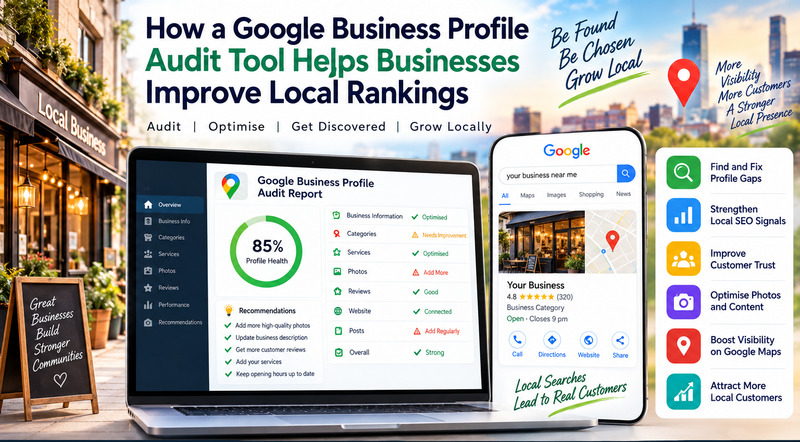
How a Google Business Profile Audit Tool Helps Businesses Improve Local Rankings
September 22, 2026
For businesses that depend on customers in a specific city, neighbourhood, or service area, appearing prominently on Google Search and Google Maps can make a significant difference to online visibility. A Google Business Profile (GBP) is one of the key assets businesses can use to establish their local presence, but simply creating a profile is not enough.
Google states that local results are primarily influenced by relevance, distance, and prominence. Complete and accurate business information can help Google understand what a business offers and match it with relevant searches. (Google Help)
This is where a Google Business Profile Audit Tool becomes useful.
What Is a Google Business Profile Audit?
A GBP audit is a systematic review of a business's Google Business Profile to identify information gaps, inconsistencies, optimisation opportunities and potential issues that may affect local visibility.
Instead of manually checking dozens of profile elements, an audit tool can organise important signals into a single report.
Depending on the tool, an audit may examine areas such as:
Instead, an audit helps a business identify areas that can be improved and monitored.
Why Google Business Profile Matters for Local SEO
Google Business Profiles appear across Google Search and Maps and can provide customers with important information such as a business's location, opening hours, website, telephone number, photos and reviews. (Google Help)
For example, someone searching for:
“digital marketing agency near me”
may see local businesses alongside their location, reviews, contact information and other profile details.
The more accurately a profile communicates what a business does and where it operates, the easier it can be for Google to interpret the business in the context of relevant local searches.
However, local ranking is not controlled by one single factor.
Google's three primary local ranking factors
According to Google, local results are mainly based on:
1. Relevance
How closely a Business Profile matches what someone is searching for.
2. Distance
How far the business is from the searcher or the location specified in the search.
3. Prominence
How well-known or established the business is, with signals including information from across the web, links and reviews. (Google Help)
A GBP audit can primarily help businesses work on the information and signals they can control, while recognising that distance and other external factors cannot simply be optimised away.
7 Ways a GBP Audit Tool Can Help
1. Identifying Incomplete Business Information
An audit can quickly identify missing or outdated information.
This may include:
A structured audit turns these checks into an actionable checklist.
2. Checking Business Categories
Categories help communicate what type of business you operate.
For example, a business could potentially be categorised around a specific service or business type rather than relying on a broad description.
An audit can flag whether the selected category information deserves review and whether the profile's services and description are consistent with the business's actual offering.
The goal should be accuracy rather than keyword stuffing.
Businesses should represent themselves honestly and use information that accurately describes their operations.
3. Reviewing Services and Products
Services can provide additional context about what a business offers.
For example, a local marketing agency might offer:
For eligible retail businesses, Google also allows products to be displayed on Business Profiles, potentially helping customers discover what is available. (Google Help)
4. Auditing Reviews and Customer Engagement
Reviews are important both for customers and for local visibility.
Google says that more reviews and positive ratings can contribute to a business's prominence in local results. Google also recommends responding to reviews to show that customer feedback is valued. (Google Help)
An audit tool can help businesses monitor:
5. Checking Photos and Visual Content
Photos can help potential customers understand a business before contacting or visiting it.
Google recommends adding photos and videos to Business Profiles. (Google Help)
A GBP audit can therefore examine whether a profile has sufficient visual content and identify opportunities to improve the presentation of:
6. Finding Local SEO Consistency Issues
A business may have different versions of its information across its website, directories and other online sources.
For example:
Google Business Profile:
ABC Digital, 12 Park Street
Website:
ABC Digital Marketing, 12 Park St.
Directory:
ABC Digital Agency, Park Street
An audit can help identify discrepancies that deserve review.
Google explains that information shown in local search can come from multiple sources, including the business's website, third-party data, user contributions and information supplied through Business Profiles. (Google Help)
Maintaining accurate information across important online properties therefore supports a more consistent local presence.
7. Turning Performance Data Into Action
An audit should not stop at checking whether information exists.
Performance data can help businesses understand what happens after people discover their profile.
Google Business Profile performance reporting can include metrics such as:
For example, suppose an audit reveals:
High profile views + low website clicks
That could prompt a business to review its website link, landing page and customer proposition.
Similarly:
High profile views + low calls
could encourage the business to review its contact information, services, profile content and customer journey.
The data doesn't automatically explain why performance is happening, but it gives businesses useful evidence for deciding what to investigate next.
GBP Audit vs. Manual Checking
A manual audit can work for a single business, but it becomes time-consuming when an agency manages multiple locations.
For agencies, franchises and businesses with multiple locations, structured auditing can make local SEO management considerably easier.
What Should a Good GBP Audit Report Include?
A useful report should go beyond a simple percentage score.
A practical audit can include:
Profile Health
Most importantly, the report should explain what needs attention and what to do next.
How Businesses Can Use an Audit Strategically
A GBP audit becomes more valuable when it is part of an ongoing local SEO process.
A simple workflow could look like this:
Audit → Identify Issues → Prioritise → Implement Changes → Monitor → Re-Audit
Step 1: Audit
Create a baseline of the current Business Profile.
Step 2: Identify Issues
Separate critical information problems from optimisation opportunities.
Step 3: Prioritise
Address inaccurate information, verification or compliance issues and major profile gaps before lower-priority improvements.
Step 4: Implement
Update the profile and relevant website or local citations where appropriate.
Step 5: Monitor
Use available Business Profile performance data to understand changes in customer interactions. (Google Help)
Step 6: Re-Audit
Repeat the process periodically to identify new gaps and maintain profile accuracy.
Can a GBP Audit Guarantee Higher Rankings?
No.
This is an important distinction in local SEO.
An audit tool can identify optimisation opportunities, but it cannot guarantee a position in Google's local results.
Google states that local rankings depend primarily on relevance, distance and prominence, and that businesses cannot pay Google to obtain a better local ranking. (Google Help)
Search results can also vary depending on the searcher's location and query.
Therefore, a responsible GBP audit should be positioned as a diagnostic and optimisation tool, not a ranking guarantee.
The Bigger Picture: GBP + Website + Reputation
A Business Profile shouldn't be treated as an isolated SEO asset.
Google can use information from the business's official website and other sources when compiling information about businesses and local places. (Google Help)
That means a strong local SEO strategy can bring together:
Google Business Profile
↓
Local Website SEO
↓
Reviews & Reputation
↓
Relevant Local Content
↓
Accurate Business Information Across the Web
↓
Performance Measurement
Businesses can also connect their Business Profile with Google Analytics to analyse local listing interactions alongside website and app data, providing a broader view of the customer journey. (Google Help)
Final Thoughts
A Google Business Profile Audit Tool gives businesses a structured way to understand how their local presence currently looks and where improvements may be possible.
Instead of guessing why a business isn't receiving enough local enquiries, businesses can systematically examine profile completeness, categories, services, reviews, visual content, business information and available performance data.
The most effective approach is not to treat an audit score as the goal. The goal is to use the audit to create a practical improvement plan, implement accurate changes, monitor customer interactions and continually maintain the profile.
Local SEO is an ongoing process—not a one-time setup.
Ready to Audit Your Google Business Profile?
If you're looking to understand your local search presence, a Google Business Profile Audit Tool can help uncover optimisation opportunities and turn them into actionable tasks.
Audit your profile. Identify gaps. Improve your local presence. Track the results.
Frequently Asked Questions
What is a Google Business Profile audit?
A GBP audit is a structured review of a Business Profile to identify missing, inaccurate or potentially improvable information and local SEO opportunities.
Does a GBP audit guarantee better Google rankings?
No. Google says local ranking is primarily based on relevance, distance and prominence, and there is no way to pay for a better local ranking. (Google Help)
How often should I audit my Google Business Profile?
Businesses can benefit from periodic audits, particularly after changing their services, location, contact details, opening hours or website. Performance data can also be reviewed over selected date ranges to identify changes over time. (Google Help)
Can an audit check reviews?
Yes. A comprehensive audit can examine review activity, ratings and whether businesses are responding to customer feedback.
Can a GBP audit help with Google Maps visibility?
It can identify areas of the profile that may affect how accurately Google understands and presents the business, but it cannot guarantee a particular Maps position. Google uses relevance, distance and prominence in determining local results. (Google Help)
What should I do after completing a GBP audit?
Prioritise inaccurate or missing information first, then review categories, services, reviews, photos, website alignment and performance data before conducting a follow-up audit.
Google states that local results are primarily influenced by relevance, distance, and prominence. Complete and accurate business information can help Google understand what a business offers and match it with relevant searches. (Google Help)
This is where a Google Business Profile Audit Tool becomes useful.
What Is a Google Business Profile Audit?
A GBP audit is a systematic review of a business's Google Business Profile to identify information gaps, inconsistencies, optimisation opportunities and potential issues that may affect local visibility.
Instead of manually checking dozens of profile elements, an audit tool can organise important signals into a single report.
Depending on the tool, an audit may examine areas such as:
- Business name and profile information
- Primary and secondary categories
- Business description
- Address and service-area information
- Phone number and website
- Opening hours and special hours
- Business attributes
- Services and products
- Photos and videos
- Customer reviews and responses
- Profile completeness
- Website and local SEO signals
- Search visibility and performance data
- Potential profile inconsistencies
Instead, an audit helps a business identify areas that can be improved and monitored.
Why Google Business Profile Matters for Local SEO
Google Business Profiles appear across Google Search and Maps and can provide customers with important information such as a business's location, opening hours, website, telephone number, photos and reviews. (Google Help)
For example, someone searching for:
“digital marketing agency near me”
may see local businesses alongside their location, reviews, contact information and other profile details.
The more accurately a profile communicates what a business does and where it operates, the easier it can be for Google to interpret the business in the context of relevant local searches.
However, local ranking is not controlled by one single factor.
Google's three primary local ranking factors
According to Google, local results are mainly based on:
1. Relevance
How closely a Business Profile matches what someone is searching for.
2. Distance
How far the business is from the searcher or the location specified in the search.
3. Prominence
How well-known or established the business is, with signals including information from across the web, links and reviews. (Google Help)
A GBP audit can primarily help businesses work on the information and signals they can control, while recognising that distance and other external factors cannot simply be optimised away.
7 Ways a GBP Audit Tool Can Help
1. Identifying Incomplete Business Information
An audit can quickly identify missing or outdated information.
This may include:
- Incorrect opening hours
- Missing website URL
- Incorrect telephone number
- Incomplete business description
- Missing services
- Missing attributes
- Incorrect address or service-area information
A structured audit turns these checks into an actionable checklist.
2. Checking Business Categories
Categories help communicate what type of business you operate.
For example, a business could potentially be categorised around a specific service or business type rather than relying on a broad description.
An audit can flag whether the selected category information deserves review and whether the profile's services and description are consistent with the business's actual offering.
The goal should be accuracy rather than keyword stuffing.
Businesses should represent themselves honestly and use information that accurately describes their operations.
3. Reviewing Services and Products
Services can provide additional context about what a business offers.
For example, a local marketing agency might offer:
- SEO
- Social media marketing
- Google Business Profile management
- Website development
- Paid advertising
For eligible retail businesses, Google also allows products to be displayed on Business Profiles, potentially helping customers discover what is available. (Google Help)
4. Auditing Reviews and Customer Engagement
Reviews are important both for customers and for local visibility.
Google says that more reviews and positive ratings can contribute to a business's prominence in local results. Google also recommends responding to reviews to show that customer feedback is valued. (Google Help)
An audit tool can help businesses monitor:
- Review volume
- Average rating
- Recent review activity
- Unanswered reviews
- Review-response coverage
- Recurring customer feedback themes
5. Checking Photos and Visual Content
Photos can help potential customers understand a business before contacting or visiting it.
Google recommends adding photos and videos to Business Profiles. (Google Help)
A GBP audit can therefore examine whether a profile has sufficient visual content and identify opportunities to improve the presentation of:
- Premises
- Products
- Services
- Team
- Work examples
- Brand identity
6. Finding Local SEO Consistency Issues
A business may have different versions of its information across its website, directories and other online sources.
For example:
Google Business Profile:
ABC Digital, 12 Park Street
Website:
ABC Digital Marketing, 12 Park St.
Directory:
ABC Digital Agency, Park Street
An audit can help identify discrepancies that deserve review.
Google explains that information shown in local search can come from multiple sources, including the business's website, third-party data, user contributions and information supplied through Business Profiles. (Google Help)
Maintaining accurate information across important online properties therefore supports a more consistent local presence.
7. Turning Performance Data Into Action
An audit should not stop at checking whether information exists.
Performance data can help businesses understand what happens after people discover their profile.
Google Business Profile performance reporting can include metrics such as:
- Searches
- Profile views
- Calls
- Website clicks
- Direction requests
- Messages
- Bookings
- Products
- Offers
For example, suppose an audit reveals:
High profile views + low website clicks
That could prompt a business to review its website link, landing page and customer proposition.
Similarly:
High profile views + low calls
could encourage the business to review its contact information, services, profile content and customer journey.
The data doesn't automatically explain why performance is happening, but it gives businesses useful evidence for deciding what to investigate next.
GBP Audit vs. Manual Checking
A manual audit can work for a single business, but it becomes time-consuming when an agency manages multiple locations.
| Manual Review | GBP Audit Tool |
|---|---|
| Information checked individually | Information organised in one report |
| Time-consuming | Faster analysis |
| Easy to overlook fields | Structured checklist |
| Difficult to compare locations | Easier multi-location comparison |
| Manual reporting | Automated or semi-automated reporting |
| Repeated checks | Easier recurring audits |
What Should a Good GBP Audit Report Include?
A useful report should go beyond a simple percentage score.
A practical audit can include:
Profile Health
- Verification status
- Completeness
- Missing information
- Potential inconsistencies
- Category relevance
- Services
- Location information
- Website connection
- Local search signals
- Review volume
- Rating
- Recent reviews
- Response activity
- Photos
- Videos
- Products
- Services
- Posts or offers where relevant
- Searches
- Views
- Calls
- Website clicks
- Directions
- Other available interactions
Most importantly, the report should explain what needs attention and what to do next.
How Businesses Can Use an Audit Strategically
A GBP audit becomes more valuable when it is part of an ongoing local SEO process.
A simple workflow could look like this:
Audit → Identify Issues → Prioritise → Implement Changes → Monitor → Re-Audit
Step 1: Audit
Create a baseline of the current Business Profile.
Step 2: Identify Issues
Separate critical information problems from optimisation opportunities.
Step 3: Prioritise
Address inaccurate information, verification or compliance issues and major profile gaps before lower-priority improvements.
Step 4: Implement
Update the profile and relevant website or local citations where appropriate.
Step 5: Monitor
Use available Business Profile performance data to understand changes in customer interactions. (Google Help)
Step 6: Re-Audit
Repeat the process periodically to identify new gaps and maintain profile accuracy.
Can a GBP Audit Guarantee Higher Rankings?
No.
This is an important distinction in local SEO.
An audit tool can identify optimisation opportunities, but it cannot guarantee a position in Google's local results.
Google states that local rankings depend primarily on relevance, distance and prominence, and that businesses cannot pay Google to obtain a better local ranking. (Google Help)
Search results can also vary depending on the searcher's location and query.
Therefore, a responsible GBP audit should be positioned as a diagnostic and optimisation tool, not a ranking guarantee.
The Bigger Picture: GBP + Website + Reputation
A Business Profile shouldn't be treated as an isolated SEO asset.
Google can use information from the business's official website and other sources when compiling information about businesses and local places. (Google Help)
That means a strong local SEO strategy can bring together:
Google Business Profile
↓
Local Website SEO
↓
Reviews & Reputation
↓
Relevant Local Content
↓
Accurate Business Information Across the Web
↓
Performance Measurement
Businesses can also connect their Business Profile with Google Analytics to analyse local listing interactions alongside website and app data, providing a broader view of the customer journey. (Google Help)
Final Thoughts
A Google Business Profile Audit Tool gives businesses a structured way to understand how their local presence currently looks and where improvements may be possible.
Instead of guessing why a business isn't receiving enough local enquiries, businesses can systematically examine profile completeness, categories, services, reviews, visual content, business information and available performance data.
The most effective approach is not to treat an audit score as the goal. The goal is to use the audit to create a practical improvement plan, implement accurate changes, monitor customer interactions and continually maintain the profile.
Local SEO is an ongoing process—not a one-time setup.
Ready to Audit Your Google Business Profile?
If you're looking to understand your local search presence, a Google Business Profile Audit Tool can help uncover optimisation opportunities and turn them into actionable tasks.
Audit your profile. Identify gaps. Improve your local presence. Track the results.
Frequently Asked Questions
What is a Google Business Profile audit?
A GBP audit is a structured review of a Business Profile to identify missing, inaccurate or potentially improvable information and local SEO opportunities.
Does a GBP audit guarantee better Google rankings?
No. Google says local ranking is primarily based on relevance, distance and prominence, and there is no way to pay for a better local ranking. (Google Help)
How often should I audit my Google Business Profile?
Businesses can benefit from periodic audits, particularly after changing their services, location, contact details, opening hours or website. Performance data can also be reviewed over selected date ranges to identify changes over time. (Google Help)
Can an audit check reviews?
Yes. A comprehensive audit can examine review activity, ratings and whether businesses are responding to customer feedback.
Can a GBP audit help with Google Maps visibility?
It can identify areas of the profile that may affect how accurately Google understands and presents the business, but it cannot guarantee a particular Maps position. Google uses relevance, distance and prominence in determining local results. (Google Help)
What should I do after completing a GBP audit?
Prioritise inaccurate or missing information first, then review categories, services, reviews, photos, website alignment and performance data before conducting a follow-up audit.
Ready to scale?
Apply these strategies directly to your brand with our expert team.
Get a Free Audit